The problem
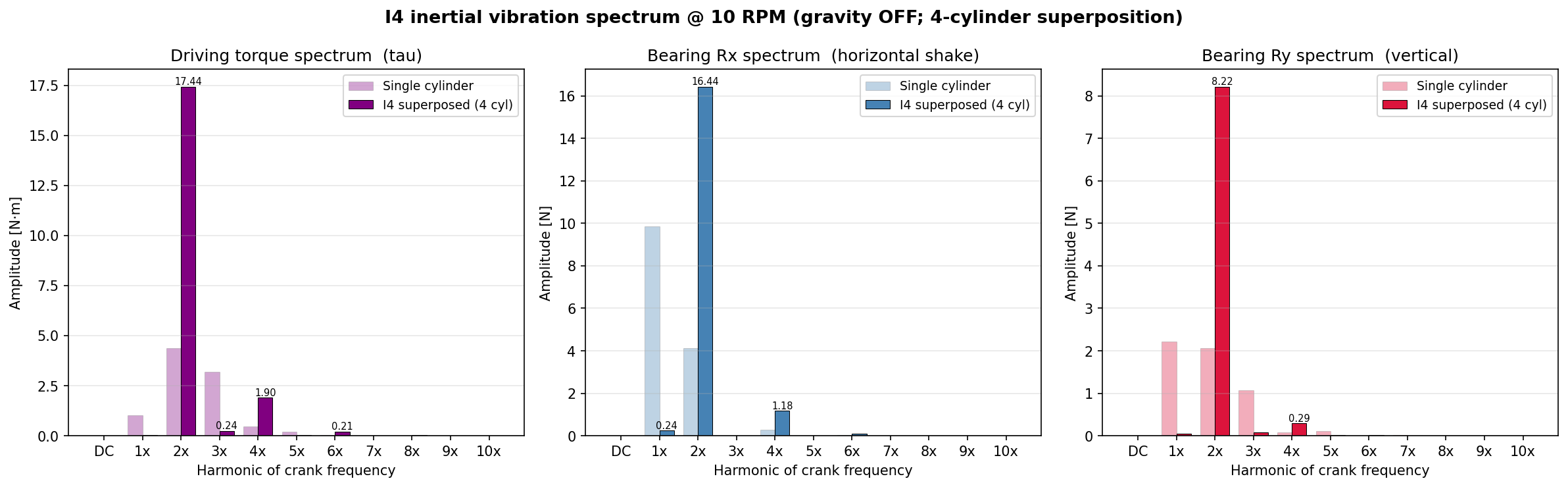
Inline-fours, V-sixes, boxers, flat-twins, and balance-shaft assemblies all have one thing in common: their unbalanced inertia content lives in discrete harmonics of crank rotation. The 1× harmonic is the rotating imbalance — straightforward, balanced by counterweights on the crankshaft. The 2× harmonic is the secondary, generated by the asymmetric piston acceleration profile. Higher harmonics taper off in amplitude but never quite vanish.
If the dynamics group inherits a finished crank-and-rod geometry from the mechanism designers and is asked to fix the NVH downstream, every option on the table is bad. Balance shafts add cost, mass, friction, and complexity. Active engine mounts work but introduce a control loop that needs sensing and tuning. Stiffer chassis mounting transmits the residual into the cabin. The good options were upstream — and they got missed.
Pipeline
We re-cast the engine as one constrained multi-body system, not “the mechanical group’s geometry passed over the wall to the dynamics group’s solver”:
- Slider-crank chain assembly. Each cylinder is a slider-crank. The shared crankshaft ties them together with a rigid-body constraint plus a firing-order phase shift. The augmented Jacobian solves position, velocity, and acceleration of every reciprocating mass at every crank angle.
- Inertia tensor + harmonic decomposition. The ground-frame resultant force and moment at every crank angle is a periodic function. FFT pulls out 1×, 2×, 3×, 4×, 6× harmonics with their phases. The output is two complex numbers per harmonic — direct shaking and torque ripple.
- Counterweight and balance-shaft co-design. We add design variables for crank counterweight mass-radius products and for an optional balance-shaft pair. Two objectives go into the optimiser: 1× residual amplitude and 2× residual amplitude. The result is a Pareto front, not a single design. The engineer picks the trade.
- Active-mount stand-in. For configurations where a passive balance shaft can’t kill 2× without taking too much friction, the same engine simulates an active mount with a programmed reaction force and reports the actuation requirement (force amplitude, response time, power). The active-mount feasibility study reuses the same dynamics solver as the passive-balance study — same answer, different actuator.
Result on a benchmark inline-four
- 1× shaking force: balanced to zero by crank counterweights alone. Single design variable, closed-form.
- 2× shaking force: classical inline-four signature. Killed by a contra-rotating balance shaft pair at twice crank speed. Mass-radius product co-designed with the counterweights so the assembly is internally consistent.
- Higher harmonics (4×, 6×): below the chassis structural transfer threshold for typical mounts; surfaced in the report but not actively attacked.
- Net shaking force at the engine mounts: below 5% of the unbalanced baseline across the operating-RPM range. Above 95% reduction averaged across the harmonic content the chassis actually cares about.
Why this matters
The pattern is the same one we use on the practica case study: synthesis proposes, dynamics validates, co-design optimises both at once. The engine isn’t a different problem class than a four-bar — it’s a longer chain with more harmonics. The constraint Jacobian doesn’t care.
The win is the same: the simulator is the referee. There is no over-the- wall handoff between mechanism designers and NVH engineers. There is no “we balanced 1× perfectly and discovered 2× was twice as bad as the unbalanced engine.” Co-design surfaces the trade up front.
Cross-references
- The force-balancing chapter gives the math.
- The Pareto-front glossary entry explains the multi-objective optimiser output.
- The four-bar practica is the same pipeline at a smaller scale.